

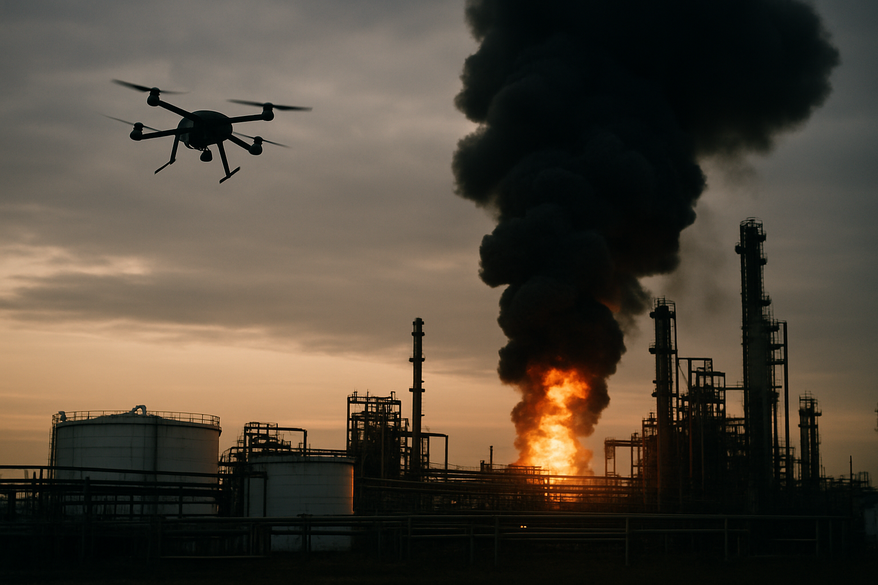
Ukrainian drone strikes and the oil and gas sector: lessons for operators and manufacturers
At Teknologam Sdn Bhd we follow geopolitically driven risks closely, especially when they affect energy infrastructure. Recent use of drones in the Russia–Ukraine theater has shifted threat models for oil and gas operators. We assess tactical patterns, engineering responses, and commercial implications from an industry supplier perspective. This article translates those observations into practical guidance for field engineering and asset resilience.
Key Takeaways:
- The operational environment has changed: unmanned aerial systems now threaten above-ground oil and gas assets in contested areas.
- Technical mitigation requires layered defenses, hardened components, rapid repair protocols, and remote monitoring investments.
- For suppliers, this means product redesign, new service offerings, and closer collaboration with operators on resilience planning.
Strategic context: how drones alter risk calculus
The Russia–Ukraine conflict has shown how relatively low-cost unmanned systems can inflict outsized damage on energy infrastructure. Operators once focused on cyber and pipeline corrosion now face kinetic, small-arms, and aerial threats. These incidents force a reassessment of site layouts, access control, and surveillance investments across production, storage, and transport nodes.
Enhanced situational awareness becomes essential at every terminal and compressor station.
Ukrainian forces and non-state actors deploy small tactical drones to probe defenses, target storage tanks, and disrupt supply routes. Reports of drone strikes on terminals underscore the transnational risk to assets near frontlines and in transit corridors. Risk managers must now integrate active-defense scenarios into continuity planning — from detection and attribution to escalation control and recovery. For practical counter-UAS measures and recommended practices, operators can refer to official guidance on countering unmanned aircraft systems: CISA guidance on Countering Unmanned Aircraft Systems.
We view threat adaptation as an engineering rather than only a security problem. Hardening and smart detection reduce both risk and downtime.
Tactical impacts on operations and asset design
Drone strikes tend to exploit visible vulnerabilities: large exposed tanks, routing choke points, and inadequately shielded pipelines. Aerial attacks also complicate emergency response by creating hazards from secondary fires and unexploded ordnance. In the field, rapid assessment and modular repair kits shorten outages and lower repair costs.
Key field mitigations:
- Retrofit shielding and blast-resistant cladding for tanks and critical piping
- Distributed shutoff valves and sectionalization to limit spill scope
- Remote-operated valves for safer emergency isolation
- Localized sensor fusion (visual, acoustic, RF) to speed detection and classification
- Pre-staged modular repair kits and trained rapid-response teams to minimize exposure
Operators must balance capital costs against probable loss scenarios. For many assets, modest physical reinforcement and improved segmentation reduce exposure more cost-effectively than continuous armed protection. Additionally, improved telemetry and automated anomaly detection help identify incidents earlier, limiting environmental and commercial impact.
Engineering and supply responses from manufacturers
Manufacturers should adapt product lines to meet emerging resilience needs. Teknologam Sdn Bhd is reviewing materials, joint designs, and modular spare systems that accelerate field replacement. We prioritize components that reduce manual exposure during repairs and simplify logistics under contested conditions.
Key Insight: Design for rapid swap-out and remote operation to minimize repair times and on-site personnel risk.
Specific product strategies include:
- Standardized modular skids that allow pump and control replacements within hours
- Composite or armored housings for critical sensors and actuators
- Hardened telemetry nodes with redundant communication paths
- Simplified mechanical interfaces to enable quick, tool-minimal swaps
- Remote diagnostics and fault-tolerant control logic to permit safe unmanned isolation
These changes also open services revenue: pre-positioned repair caches, emergency mobilization contracts, and resilience audits tailored to aerial-threat scenarios. Suppliers that offer validated, field-proven modular kits and rapid deployment services will be more attractive to operators managing elevated kinetic risk.
Commercial and supply-chain implications
The use of drones in the Russia–Ukraine theater and related attacks affect insurance, contracting, and procurement. Insurers may exclude certain conflict zones, raise premiums, or require stricter mitigation. Contractors will need clauses covering force majeure in kinetic-threat environments and clearer responsibilities for asset hardening.
Supply chains face heightened disruption risk. Sourcing critical valves, sensors, and spare parts from a single region magnifies downtime after an attack. Suppliers and operators should diversify vendors, maintain regional stockpiles, and build logistical redundancy.
Risk-management frameworks that emphasize resilience and supply-chain transparency help buyers and vendors align on acceptable trade-offs and lead-times. For structured guidance on managing risk, resilience, and supplier responsibilities as part of enterprise risk planning, see the NIST Cybersecurity Framework and resilience guidance.
Reports that drones have hit transit hubs highlight the need for route security and supplier contingency planning. Buyers should request resilience specifications, validated lead-time guarantees, and clear repair SLAs from vendors.
Close collaboration between operators and manufacturers shortens the procurement cycle and improves repair outcomes under stress.
Practical next steps for operators and suppliers
- Conduct a resilience audit focused on aerial threats and prioritize mitigations by business impact.
- Specify modular, easily replaceable components in new procurements to reduce Mean Time To Repair.
- Establish local caches of critical spares and train rapid-response teams for safe recovery operations.
- Adopt layered detection (visual + RF + acoustic) and vetted counter-UAS policies that respect legal constraints and escalation protocols.
- Update contracts and insurance disclosures to reflect kinetic-threat scenarios and clarify responsibilities for hardening and emergency response.
Conclusion
The evolving use of unmanned aerial systems in the Russia–Ukraine conflict reshapes how the oil and gas industry thinks about asset protection. Teknologam Sdn Bhd sees opportunity to support clients through hardened product design, modular repair solutions, and targeted services. By integrating threat-aware engineering, operators can reduce downtime and preserve supply reliability even in contested environments.