

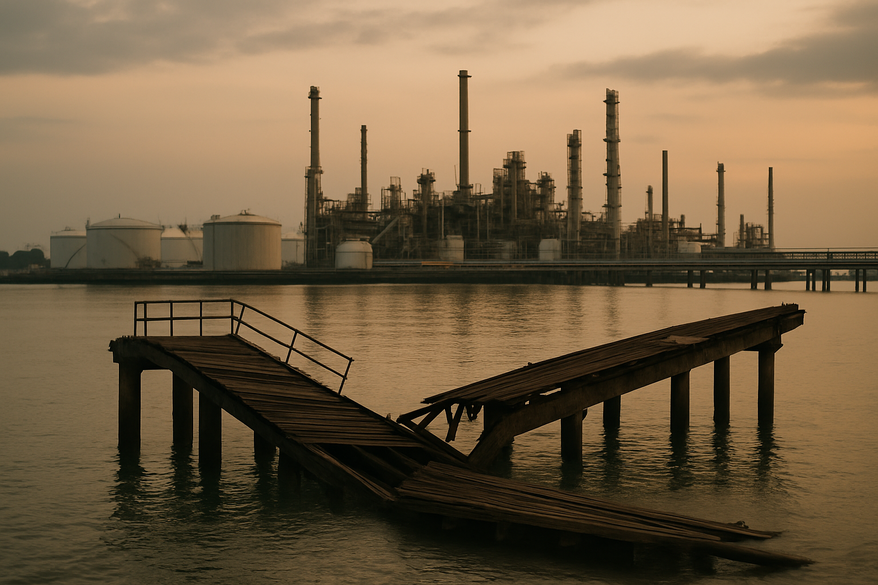
Incident summary and industry view
Teknologam Sdn Bhd has monitored the recent Port Dickson disruption closely. Our operations team reviewed initial reports and assessed potential equipment impacts. We recognise the safety-first response and the immediate suspension of processing activities. This event highlights resilience gaps in coastal terminal infrastructure during strong weather.
Key takeaways:
- Petron’s immediate shutdown reduces short-term regional supply risk.
- Reinforced jetty design and emergency mooring systems are now higher priorities.
- Teknologam will evaluate component-level retrofit opportunities for terminals.
What happened: timeline and immediate facts
Local reports indicate a jetty failure at Port Dickson after severe weather. Multiple sources state Petron’s jetty collapsed and operations were halted after the storm. Petron moved quickly to stop refining activity while teams inspected structural integrity and safety systems.
We prioritise personnel safety and environmental protection. Early containment and monitoring prevented escalation.
Initial operational notices emphasised a controlled halt. Authorities reported no oil spill and no injuries, though the tropical storm damaged port infrastructure. Emergency crews secured access and isolated hydrocarbon transfer lines while structural teams began preliminary assessments.
Technical assessment: likely causes and structural concerns
Observed damage patterns are consistent with extreme lateral wave and current forces on exposed pile-supported jetties. Scour around pile foundations commonly accelerates failure during storm surges; corrosion and fatigue can further reduce capacity and lead to sudden collapse.
Contributing mechanisms we are tracking:
- Uneven load transfer from moored vessels
- Localised scour undermining pile supports
- Deferred maintenance or inspection gaps
Repair planning must account for dynamic hydrodynamic loading and vessel impact scenarios, and should include targeted forensic inspection and load testing. For guidance on coastal loading, scour mechanisms, and foundation design considerations, see the US Army Corps of Engineers Coastal Engineering Manual: US Army Corps of Engineers — Coastal Engineering Manual (EM 1110-2-1100).
Operational response and risk management
Petron halted Port Dickson operations to protect refinery integrity and prevent secondary incidents. Immediate actions included shutting intake lines, isolating tankage, and initiating contingency fuel routing. Close coordination with port authorities reduced vessel traffic and avoided transfer attempts into compromised infrastructure.
Key insight: Rapid shutdown preserved plant safety margins and avoided product-release risk.
Planned mitigation steps include temporary marine barriers, emergency pumping redundancy, accelerated structural repairs, and review of mooring practices. Strengthening mooring and terminal equipment — and ensuring they meet modern industry standards for emergency scenarios — will be critical. Industry mooring and terminal guidance can help shape retrofit and emergency-moorage specifications: OCIMF Mooring Equipment Guidelines (MEG4).
Teknologam stands ready to supply attrition-resistant components for marine loading arms and reinforced skids, and to support emergency repairs.
Business and supply implications
Short-term throughput reductions may tighten regional product availability. Downstream customers should expect logistical reprioritisation and potential temporary price variances. Longer outages could shift cargoes to alternate Malaysian and Singapore terminals.
Contingency planning at the refinery and among suppliers will determine market resilience. We recommend fast-track inspections and spare-part mobilisation to reduce outage duration.
What Teknologam can offer and next steps
We can assist with engineered replacements for loading arms, reinforced structural fittings, and corrosion-resistant components. Our field teams perform rapid assessments and produce retrofit packages to reduce future downtime.
We propose a phased restoration plan to resume safe operations quickly, combined with targeted investments in coastal terminal robustness and more frequent structural inspections.
Closing: Industry resilience depends on proactive structural maintenance, robust emergency protocols, and rapid access to specialised fabrication. Teknologam remains available to consult, supply, and deliver practical upgrades to help prevent repeat incidents.