

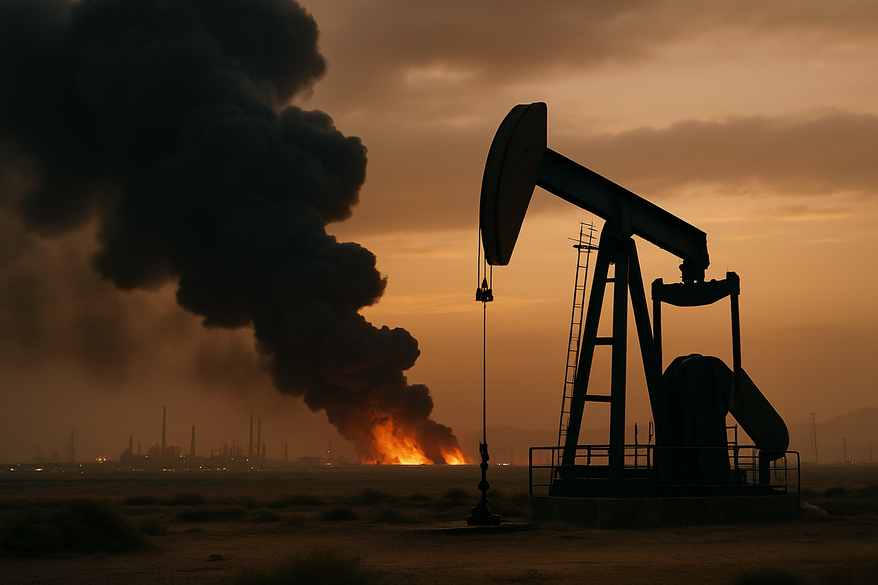
Navigating a widening Gulf of Risk: Energy, Supply and Strategy
Teknologam Sdn Bhd watches unfolding regional tensions with direct industry concern. We design and deliver equipment that relies on predictable logistics and stable demand. Rapid escalation in the Middle East forces operators to re-evaluate supply chains, asset availability, and long-term project economics. This article frames practical risks and responses for oil and gas companies and their suppliers.
Key Takeaways:
- Major market shift: global oil and gas flows will tighten, increasing volatility and insurance costs.
- Technical priority: resilience in spare parts, remote monitoring, and alternative logistics will cut downtime.
- Strategic choice: companies must balance short-term returns on fossil assets against accelerating clean energy investment.
Market shock and immediate operational risk
The headline risk is clear: regional conflict disrupts shipping, ports, and production hubs. Traders already price in higher premiums for crude and refined products during uncertainty, and buyers face tightened availability and faster rollovers to spot markets.
Immediate operational impacts
- Ports reroute shipments.
- Insurance premiums climb.
- Time-to-repair extends for offshore assets.
Shipping delays cascade into maintenance backlogs. Contractors face restricted access to yards and slower transit for critical components. For a manufacturer like us, lead-time risk translates directly into project timing risk for clients and greater exposure to demobilization or penalty clauses.
Operational mitigation (practical steps)
- Reschedule non-critical maintenance away from peak-risk windows.
- Prioritize critical-path spares and validated alternate suppliers.
- Increase visibility into shipment ETAs and customs hold patterns.
"We prioritize dual sourcing and pre-positioned critical spares to avoid project slippage," says our supply chain lead.
How conflict reshapes demand and the energy transition
Markets react quickly to uncertainty. Headlines that highlight chaos for oil and gas capture the fear-driven, short-term move toward hydrocarbons: higher oil prices can temporarily favor fossil projects over new low-carbon investments.
At the same time, price spikes and supply insecurity often accelerate interest in resilient, homegrown energy sources. Renewables, electrification, and localized generation reduce exposure to external supply shocks and political risk. That dynamic — short-term advantage for hydrocarbons versus long-term resilience for clean energy — is central to corporate and policy decision-making.
Key insight: price-driven rushes to fossil-fuel production risk locking in emissions and complicating net-zero pathways. For context on how energy security and geopolitics interact with energy transitions, see the IRENA analysis on the geopolitics of the energy transformation: IRENA report on the geopolitics of the energy transformation.
Technical responses suppliers should adopt
Manufacturers must plan for constrained logistics, longer lead times, and heightened operational risk. Practical technical moves include strengthening inventory signals, expanding remote diagnostics, and designing for modularity to speed field swaps.
Recommended actions
- Audit critical spares and increase safety stock for single-source items.
- Harden remote monitoring for condition-based maintenance and rapid troubleshooting.
- Standardize modules for faster interchange and fewer bespoke parts.
These operational improvements reduce mean time to repair (MTTR), preserve uptime, and protect margins when mobilization and transport costs spike.
Geopolitics and Europe's industrial rebound
The narrative that regional escalation threatens Europe's reindustrialization is not hyperbole. Europe depends on secure energy and stable feedstock prices to plan capital-intensive projects. Disruptions slow capital flows, raise operating costs, and can delay electrification and decarbonization timelines.
Trade-route disruptions also shift supplier networks closer to end markets. In practice, this can encourage nearshoring, regional supplier clustering, or concentrated demand in safer basins. European manufacturers may choose to localize elements of their supply chains to reduce exposure and shorten lead times.
"Nearshoring and supplier diversification now sit at the top of procurement agendas," notes our procurement director.
For broader framing on energy security policy and the options available to governments and industry, see the International Energy Agency’s work on energy security: IEA – Energy Security topic.
Policy angles and strategic narratives
Political leaders and markets frame responses around energy security. Some argue that boosting domestic production insulates economies; others warn that doubling down on fossil capacity trades short-term security for long-term climate risk. Strategic oil reserves, diplomatic engagement, and insurance backstopping matter—but so do resilient infrastructure and coherent industrial policy.
Key insight: policy choices that favor short-term production increases risk undermining long-term energy transition goals. A balanced approach should protect operations today while preserving flexibility for decarbonization pathways.
Practical steps for clients and suppliers
We recommend a three-track approach: secure operations, manage market exposure, and advance transition planning.
Secure operations
- Test contingency plans for logistics and field repairs.
- Pre-qualify alternate yards and transport routes.
- Update maintenance schedules with risk buffers.
Manage market exposure
- Revisit contractual force majeure and escalation clauses.
- Use hedging and flexible contracting to smooth price volatility.
- Negotiate inventory and delivery SLAs tied to clear risk triggers.
Advance transition planning
- Prioritize modular, interoperable equipment in new orders.
- Invest in remote monitoring to lower OPEX and reduce onsite dependency.
- Continue targeted efficiency and low-carbon pilot projects that improve resilience.
Conclusion: measured action amid uncertainty
Regional escalation creates real and immediate challenges for the oil and gas sector and for manufacturers like Teknologam Sdn Bhd. We must protect current operations while keeping strategic focus on resilient, lower-carbon solutions. Clients who blend short-term resilience with long-term transition planning will navigate volatility more successfully.
Contact our team to discuss inventory planning, modular design options, or remote-monitoring upgrades tailored to higher-risk operating environments.