

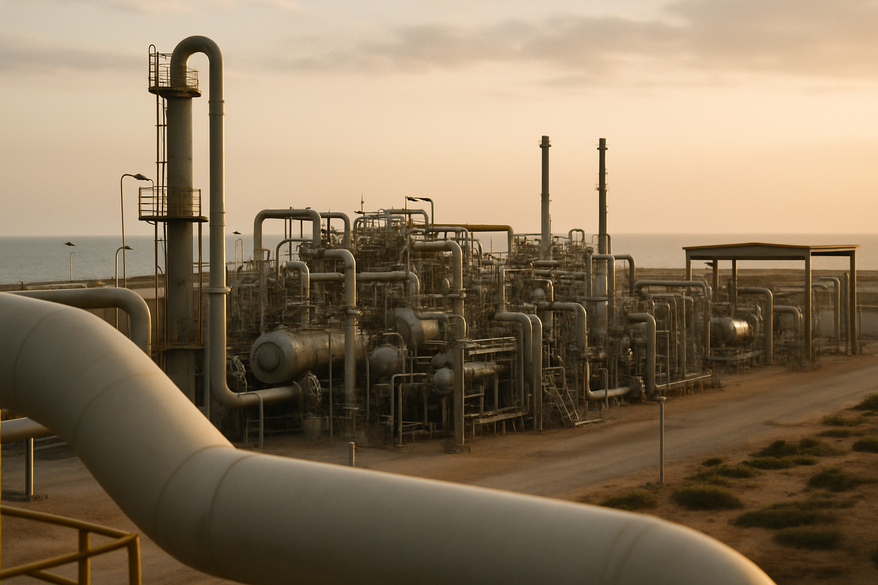
Libya's new compression capacity: what the Eni–NOC start-ups mean for supply and suppliers
As a specialist manufacturer serving rotating equipment and compression systems, Teknologam follows Libya’s recent gas compression start-ups closely. Italian energy group Eni said it has started operations on new compression facilities that support the Bahr Essalam and Sabratha fields; the coordinated start-ups were reported in the press and confirm renewed throughput capability and field support. Reuters: Eni, Libya's NOC launch Sabratha compression project. We see practical implications for equipment suppliers, maintenance planning, and supply chain readiness.
Key Takeaways:
- Eni and NOC increase Libya's gas production with start-up of compression trains, restoring throughput and supporting domestic power and exports.
- The projects underscore compression reliability, control integration, and rotating-equipment performance as decisive technical priorities.
- For Teknologam, demand will rise for robust compressor components, turn-key packages, and aftermarket services to sustain steady operations.
What was started and why it matters
Eni and the NOC brought the Sabratha compression project online to bolster output and restore previously constrained gas flows. The added compression relieves back-pressure, allowing more gas to reach processing and export pipelines. Separately, the Bahr Essalam compression capacity supports sustained field deliverability and helps reduce flaring. Together, these measures stabilise supply to power plants and contracted export volumes.
Internal note: projects that focus on compression often unlock immediate gains at modest capital cost compared with drilling new wells.
These initiatives follow several months of maintenance and upgrades across Libyan midstream assets. Public communications focus on operational readiness and cooperation between the international operator and the national company.
Technical scope and key engineering considerations
Compression increases mass flow by lowering suction pressure and raising discharge pressure to meet pipeline or process specifications. Implementing new compression involves:
- dynamic design of the compressor train,
- selecting the appropriate driver type (gas turbine, electric motor, or mechanical drive),
- and careful integration with field control and safety systems.
Operators must manage vibration, surge, and thermal effects across suction and discharge cases; in particular, surge-control and anti-surge logic are critical to protect rotating equipment and avoid production interruptions (see further discussion of surge dynamics and control approaches). Compressor surge (technical overview)
Compressor train elements:
- compressor, driver, gearbox (where needed), intercoolers, filters, and pulsation control.
Control needs:
- anti-surge systems, online monitoring, coordinated safety logic, and control redundancy.
Maintenance focus:
- shaft alignment and balancing, rotor dynamics checks, seal and packing systems, bearing condition and lubricating oil management.
Compression upgrades often require auxiliary-system upgrades as well: fuel-gas conditioning, cooler capacity, and electrical or mechanical driver interfaces must all be aligned. Teknologam’s experience in precision components and balancing can shorten turnaround times and reduce commissioning risk.
Operational impacts and market implications
The immediate outcome is higher gas availability for domestic power generation and industrial customers. Increased pipeline throughput can also free contracted volumes for export under regional agreements. Reliability will hinge on compressor uptime, spare-part logistics, and disciplined predictive maintenance.
Key Insight: small-to-midsize compression projects deliver outsized operational gains, but they demand disciplined engineering and local supply readiness.
For contractors and suppliers, the program signals near-term demand for consumables and rotating-equipment spares. Vendors should prioritise inventory for seals, bearings, couplings, and control modules. Remote monitoring and condition-based maintenance tools will become competitive differentiators.
What this means for Teknologam and our clients
We view these start-ups as a call to action for lifecycle support in North Africa. Teknologam can offer:
- matched-component kits,
- bespoke shaft and rotor services,
- rapid-response teams to minimise downtime,
- and design-for-maintainability approaches that reduce mean time to repair and support safe commissioning.
Clients should reassess supply contracts to include faster lead times and robust parts kits, and evaluate condition-monitoring upgrades to detect rotor imbalance, seal leakage, and bearing wear early.
Our team recommends staged spare packages and onsite training for local crews to improve first-run reliability.
Outlook and next steps
As Eni and the NOC bring Sabratha and Bahr Essalam compression capacity into regular operation, attention will shift to sustained performance. Operators should track key performance indicators closely over the first 12 months: availability, mean time between failures, throughput versus design, and emissions/flare reductions. Vendors must align logistics, service-level agreements, and remote support options to meet this demand.
If you are planning upgrades or need spares and field services linked to new compression capacity, Teknologam can support specification, supply, and commissioning. Contact our engineering team to discuss project timelines, component compatibility, and aftermarket strategies.